
Station to Station

I pieced this story together in a North London care home almost twenty-five years ago, and I haven’t read it since it appeared in my book Ancient Mysteries.
When you work with large numbers of elderly people, favourites emerge naturally. Jean was not one of mine.
To be fair, she wasn’t really anyone’s favourite. Some residents make the long days easier. Jean did not.
She was difficult: snobbish, casually racist, forever groping male staff, and convinced she’d been abandoned among people beneath her. Even her son, who lived in Australia, wanted nothing to do with her. Her care notes specified that he should only be contacted when she died.
But Jean came with Ellen.
Ellen was sharp, wiry, nicotine-stained, and gloriously outspoken. She was also great fun. Jean, meanwhile, was huge, dishevelled, and usually wearing part of her lunch. On quiet afternoons, the carers would wheel them together just to watch the fireworks.
Arguments became shouting matches, and shouting matches became fights. Ellen always won.
Eventually, it ended the only way it really could: with Ellen pouring a full cup of tea over Jean’s head.
I walked into the lounge just as Jean was being wheeled out, screaming, shaking, and trying to haul herself from her wheelchair. Ellen sat beaming at me, looking as though butter wouldn’t melt.
The manager separated them after that. When I included Ellen’s story in my first book, I placed Jean’s right beside her – a small joke only I was in on.
Jean’s Story
“I’ve thought of writing my story many times but never started, so this is it.”
“I was born in the East End, in Boleyn Road, Forest Gate. My father was in the army years ago in the Great War. My mother was in what we called the Maypole, like Sainsbury’s. I don’t really know what she did, nothing special. Mind you, we weren’t a close-knit family. She could have been the boss and I wouldn’t have known. As far as I can remember, after my father left the army he was a milkman in Ilford.
“My husband was a kind of fisherman, an Oyster Bailiff in Cornwall. We met when I was stationed at Yatesbury. He’d won some kind of competition building a radio or something when he was a boy and ended up doing something for Radio Luxembourg. My service time is far more interesting.
“I was called up, called up from Romford. You got to a certain age and you got called up. There were half a dozen of us up at Maylands Aerodrome, Romford Women’s Air Reserve, and we got a chance to fly. I mean, we took the controls, and I seem to remember being in a glider, although I’m not sure why or when. That used to be along the Southend Road. That’s where I met Amy Johnson and learnt Morse code — not with Amy Johnson. She was always on her own. She was a very nice person. Of course, she was the first woman to fly across the Atlantic. Amy Johnson used to come to Maylands Aerodrome. I think she liked a drink, and we had a good bar, although I was only a kid then and we just went for fun. Romford Women’s Air Reserve - we just thought, “That sounds good, we’ll give it a go.”
“Sometimes she’d take us up flying in a Gypsy Moth. She sat in the front and we sat in the back, round and round. Us girls in them days, we thought nothing of it - just somewhere to go.
“It might have been the war, but it was good fun. We did have fun, all the young men. Then I went off to Bletchley Park.
“We didn’t call it Bletchley Park at the time; it was referred to as Station X. We were billeted to Station X, doing nights. But first of all, I had to go to Morecambe, doing our square-bashing. It was horrible - square-bashing in the pouring rain with an overcoat miles too big. You just had to do it, unless you were a conscientious objector. They were awful. We thought everybody should be in the war.
“I remember my first meal at Morecambe was kippers, which I hate. Mother had baked a fruit cake, saying, “Take this, you’ll be hungry when you get there.” There were hundreds and hundreds of us, and just a handful were picked out for Bletchley Park. We were tested on our ability to run the machines, and I was always good at numbers and anagrams.
“Then off to Compton Bassett No. 3 Radio School, eight to a hut, using the radio in code or in plain language. One hundred and twenty letters per minute translating Morse code. We used to send and receive code and would sometimes put something funny in. It got me in trouble, but I loved my work — always in code, five-letter code. There were loads of us, eight to a hut. Then to Leighton Buzzard, working the first fully automatic computer, Colossus.


“In my mind, I can see the machines going now - great big tall things with knobs everywhere. I sat for hours taking messages from India, and after that I went off to a great big house, Bletchley Park. Slept in there in great big double beds. We had tests to get selected, based on our knowledge. From Morecambe to Wiltshire, did three years there, learning absolutely everything, and Yatesbury, just a bit further up the road. They’re all air force stations. Selected for intelligence. My family were so proud - not bad at all for a milkman’s daughter.
“At the time, I thought it was just a normal job, but of course what we did has gone down in history because we had the Enigma machine. It looked just like a typewriter. It was a fantastic machine - millions of combinations of code. But I learnt more about it since than I knew at the time.
“We always worked on five-letter codes, intercepted night after night, with my headphones on taking messages. I’m not really sure if I can tell you that much. It might still be secret, and I can’t really tell you all the technical names. It was interesting work, but more than that I think we saved lives.
“We were connected with Bomber Command - our air force and the Americans, Naval Intelligence. It was all there at Bletchley Park. We needed the Americans to win the war, but they needed us just the same.
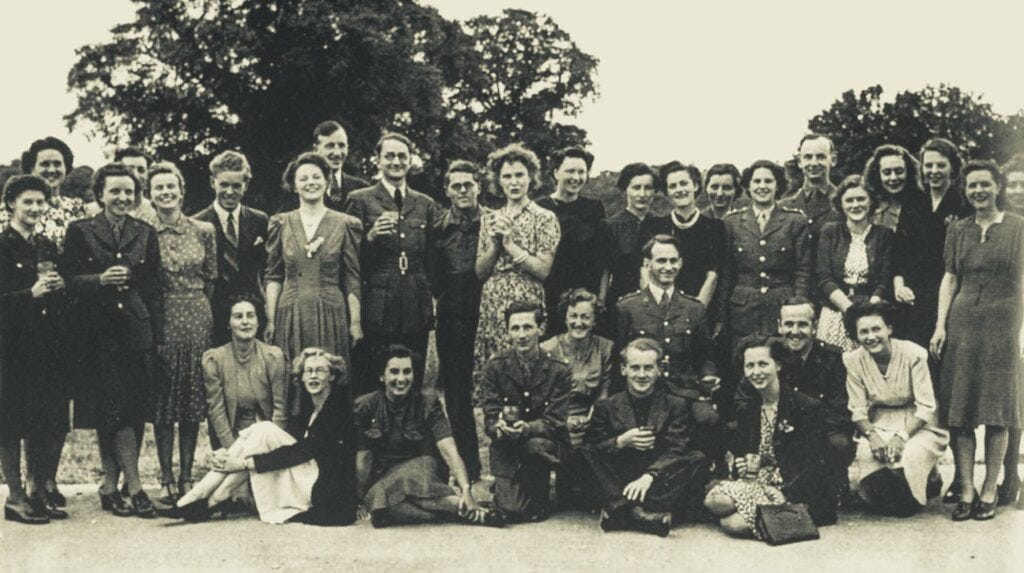
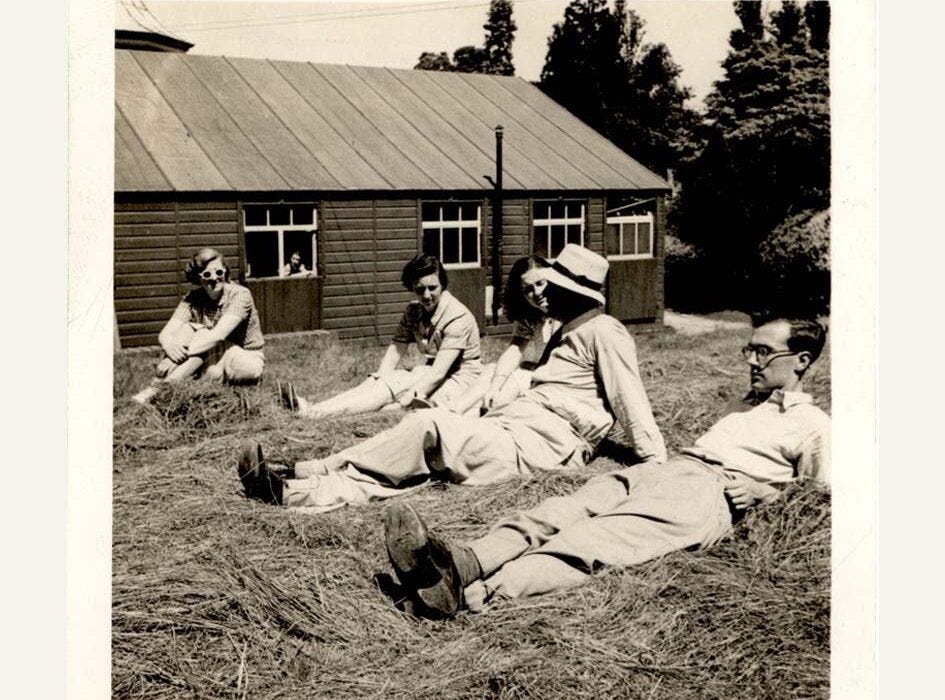
“They were young scoundrels, the Americans. Just down the road from Bletchley Park was Dorothy Paget’s stud farm. In the summer, all of us slept on top of the hay - better than in the huts. We’d come off night duty and get on the hay out in the field. Best way to sleep, men and all. We used to have fun. I remember one particular mechanic from Bletchley Park, a chap called Tucker, though we were all friends in Bletchley Park. Strange that I didn’t stay in contact with any of them.
“I wanted to go to Cairo, but my husband wouldn’t sign the release paper. He said, “You’re not going,” and that was it. I planned to go to Cairo with the same work as Bletchley Park - code-breaking. I was only a plonk, 2141258. I can even remember my boyfriend’s number, 3965223. He went to Cairo and I wanted to go with him.
“I used to take messages and put something funny in. They weren’t very pleased. There was a big row about it, told off by the C.O. But I had a boyfriend who was stationed in India, and I’d send and receive messages from him all night, so you can imagine. But I was married at the time.
“I forgot, but I was in Leighton Buzzard before Bletchley Park. Oh dear, the memories. I can see it now, going into the watch room, sending out Morse code all through the night. It’s funny - these things keep coming back at midnight, nothing in the day.
“I can still remember the German planes coming over - V2s and land mines. There were masses of them coming over at one time. You just had to get on with life; everybody did. One night I ended up sleeping near Hyde Park, and another time, when I couldn’t get home because of the bombing, I had to climb over a fence and sleep on the grass in Regent’s Park with Yanks from Norfolk. We’d hitchhike from London to Bletchley Park, riding on the back of army lorries.
“We had no money - a bob a day, a shilling a day, that’s all, until I got married. My husband was Cornish, in the air force based at Yatesbury Radio Station. Not just a radio operator; he was in intelligence as well. He went off to Burma and all those places out there - Singapore, Penang. He always wanted to go there. But of all the places I’ve been, and I’ve been all over the place, the place I like most is still London. Good old London. I had a smashing house in Prince Albert Road, beautiful flats, and Viceroy Court, a beautiful place for four or five of us. London or Marrakech - I went to Marrakech every year. Very bohemian. I travelled everywhere, even to Timbuktu.”